Showing posts with label United States. Show all posts

Monday, April 2, 2012

Pakistan PM Gilani: “China’s enemy is our enemy”


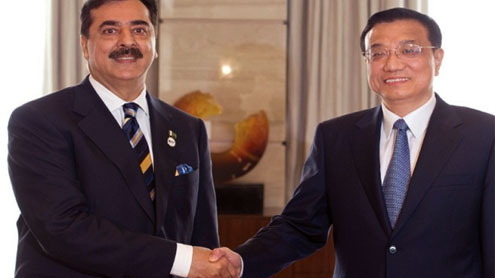
Pakistan and China moved a notch higher than their “time-tested” and “all-weather” friendship status after Pakistan Prime Minister Yousaf Raza Gilani declared that “China’s enemy is our enemy”.

“China’s friend is our friend, and China’s enemy is our enemy. We consider China’s security as our own security,” The Express Tribune quoted Gilani, as saying in a meeting with China’s Executive Vice Premier Li Keqiang at the State Guest House on the sidelines of the Boao Forum for Asia.

Keqiang reciprocated Gilani’s sentiments by saying: “No matter what changes take place at the international level, we will uphold Pakistan’s sovereignty and territorial integrity,” he said. “China supports Pakistan’s role in regional and international affairs.”

China’s reiteration of support for Pakistan’s territorial integrity came after US Congressman Dana Rohrabacher introduced a resolution in the House of Representatives seeking independence for the insurgency-hit Balochistan.

Gilani said Pakistan gives high importance to the security of Chinese citizens on its soil, and added that he was personally monitoring the process to provide them extensive protection.

He added Pakistan realises the importance of maintaining a working engagement with the United States but would not compromise its sovereignty and national dignity.

He was referring to his meeting with the US President Barack Obama in Seoul, where he told him that Pakistan’s Parliament would set the contours of future ties with the US.

Saturday, March 31, 2012

Migraines likelier in men with impotence


Men who have been diagnosed with erectile dysfunction are 63 percent more likely to also have had a diagnosis of migraine headaches than men without the sexual disorder, according to a new study from Taiwan.

Dr. Tobias Köhler of Southern Illinois University School of Medicine, who specializes in male sexual function and fertility, told Reuters Health this is the first he`s heard of any such relationship between migraines and impotence.

"It`s an interesting first recognition of the correlation, but by no means does it mean they`re causally linked," said Köhler, who was not involved in the new research. It`s not clear what might explain the link between erectile dysfunction (ED) and headache, although migraines have been linked to sexual dysfunction in women, the study authors note in the journal Cephalalgia.

But "no study to date has ever attempted to explore the association between migraine and ED," write Dr. Chao-Yuan Huang at National Taiwan University`s College of Medicine and his colleagues.

It has been estimated that about 20 million men in the United States suffer from impotence.

The research team collected information on 23,000 men from a national database of insurance claims in Taiwan.

About 5,700 of the men had been diagnosed with erectile dysfunction, which is an inability to get or keep an erection.

Huang`s group then compared ED patients to 17,000 similar men who had not sought treatment for impotence.

Among the men with ED, 245, or 4.25 percent, had previously been diagnosed with migraine headaches.

In the group without ED, 457 men, or 2.64 percent, had been diagnosed with migraines.

After the researchers took into account differences between the groups, including heart disease and diabetes, they found that ED patients were 1.63 times as likely to have had a previous migraine diagnosis as men in the other group.

Age seemed to make a difference.

Men in their 30s with erectile dysfunction were about twice as likely as men without it to have a diagnosis of migraines.

The researchers could only speculate as to why migraines are more common among men with erectile dysfunction.

"As it has been demonstrated that chronic pain can cause sexual dysfunction," the authors write, "one possible explanation for the association seen in this study may be the chronic pain associated with migraine headaches."

Köhler, who also represents the American Urological Association regarding sexual medicine, agreed that pain is a possible explanation.

"We definitely know that pain in general is bad for erections," he said.

The authors also offer up the brain chemical dopamine as a potential player, because it is thought to be involved in both migraine headaches and sexual function.

In addition, there`s the possibility that the findings could be due to some other factor. For instance, men who see a doctor for migraines might be more likely to seek care for erection problems too, Huang`s group notes.

Or it could be that the men diagnosed with migraines are taking medications that interfere with their sexual function, Köhler speculated.

Dr. Ege Serefoglu at Tulane University School of Medicine said that because this is the first stab at looking at the relationship between migraine and erectile dysfunction, the findings should be interpreted cautiously.

He added that the study was well conducted, but the results "need to be confirmed by other countries, other researchers, before we can really include migraine as a risk factor of erectile dysfunction or vice versa."

Thursday, March 29, 2012

Mumbai, Miami on list for big weather disasters


 Global warming is leading to such severe storms, droughts and heat waves that nations should prepare for an unprecedented onslaught of deadly and costly weather disasters, an international panel of climate scientists said in a new report issued Wednesday.

The greatest threat from extreme weather is to highly populated, poor regions of the world, the report warns, but no corner of the globe — from Mumbai to Miami — is immune. The document by a Nobel Prize-winning panel of climate scientists forecasts stronger tropical cyclones and more frequent heat waves, deluges and droughts.

The 594-page report blames the scale of recent and future disasters on a combination of man-made climate change, population shifts and poverty.

In the past, the Intergovernmental Panel on Climate Change, founded in 1988 by the United Nations, has focused on the slow inexorable rise of temperatures and oceans as part of global warming. This report by the panel is the first to look at the less common but far more noticeable extreme weather changes, which lately have been costing on average about $80 billion a year in damage.

"We mostly experience weather and climate through the extreme," said one of the report's top editors, Chris Field, an ecologist with the Carnegie Institution of Washington. "That's where we have the losses. That's where we have the insurance payments. That's where things have the potential to fall apart.

"There are lots of places that are already marginal for one reason or another," Field said. But it's not just poor areas: "There is disaster risk almost everywhere."

The report specifically points to New Orleans during 2005's Hurricane Katrina, noting that "developed countries also suffer severe disasters because of social vulnerability and inadequate disaster protection."

In coastal areas of the United States, property damage from hurricanes and rising seas could increase by 20 percent by 2030, the report said. And in parts of Texas, the area vulnerable to storm surge could more than double by 2080.

Already US insured losses from weather disasters have soared from an average of about $3 billion a year in the 1980s to about $20 billion a year in the last decade, even after adjusting for inflation, said Mark Way, director of sustainability at insurance giant Swiss Re. Last year that total rose to $35 billion, but much of that was from tornadoes, which scientists are unable to connect with global warming. U.S. insured losses are just a fraction of the overall damage from weather disasters each year.

Globally, the scientists say that some places, particularly parts of Mumbai in India, could become uninhabitable from floods, storms and rising seas. In 2005, over 24 hours nearly 3 feet of rain fell on the city, killing more than 1,000 people and causing massive damage. Roughly 2.7 million people live in areas at risk of flooding.

Other cities at lesser risk include Miami, Shanghai, Bangkok, China's Guangzhou, Vietnam's Ho Chi Minh City, Myanmar's Yangon and India's Kolkata. The people of small island nations, such as the Maldives, may also need to abandon their homes because of rising seas and fierce storms.

"The decision about whether or not to move is achingly difficult and I think it's one that the world community will have to face with increasing frequency in the future," Field said in a telephone news conference Wednesday.

This report — the summary of which was issued in November — is unique because it emphasizes managing risks and how taking precautions can work, Field said. In fact, the panel's report uses the word "risk" 4,387 times.

Field pointed to storm-and-flood-prone Bangladesh, an impoverished country that has learned from its past disasters. In 1970, a Category 3 tropical cyclone named Bhola killed more than 300,000 people. In 2007, the stronger cyclone Sidr killed only 4,200 people. Despite the loss of life, Bangladesh is considered a success story because it was better prepared and invested in warning and disaster prevention, Field said.

A country that was not as prepared, Myanmar, was hit with a similar sized storm in 2008, which killed 138,000 people.

The study forecasts that some tropical cyclones — which include hurricanes in the United States — will be stronger because of global warming. But the number of storms is not predicted to increase and may drop slightly.

Some other specific changes in severe weather that the scientists said they had the most confidence in predicting include more heat waves and record hot temperatures worldwide and increased downpours in Alaska, Canada, northern and central Europe, East Africa and north Asia,

IPCC Chairman Rajendra Pachauri told The Associated Press that while all countries are hurt by increased climate extremes, the overwhelming majority of deaths occur in poorer, less developed places. Yet, it is wealthy nations that produce more greenhouse gases from burning fossil fuels, raising the issue of fairness.

Some weather extremes aren't deadly, however. Sometimes, they are just strange.

Report co-author David Easterling of the National Climatic Data Center says this month's US heat wave, while not deadly, fits the pattern of worsening extremes. The US has set nearly 6,800 high temperature records in March. Last year, the United States set a record for billion-dollar weather disasters, though many were tornadoes.

"When you start putting all these events together, the insurance claims, it's just amazing," Easterling said. "It's pretty hard to deny the fact that there's got to be some climate signal."

Northeastern University engineering and environment professor Auroop Ganguly, who didn't take part in writing the IPCC report, praised it and said the extreme weather it highlights "is one of the major and important types of what we would call 'global weirding.'" It's a phrase that some experts have been starting to use more to describe climate extremes.

Field doesn't consider the term inaccurate, but he doesn't use it.

"It feels to me like it might give the impression we are talking about amusing little stuff when we are, in fact, talking about events and trends with the potential to have serious impacts on large numbers of people."
Tuesday, March 27, 2012

US, China, S Korea urge nations to lock down nukes


The leaders of South Korea, the United States and China issued stark warnings Today about the threat of nuclear terrorism during the final day of a nuclear summit that has so far been upstaged by North Korea's long-range rocket launch plans.

Nearly 60 leaders have gathered for the two-day conference meant to find ways to keep terrorists from detonating an atomic weapon in a major city. The leaders were to release a communique Tuesday about their efforts to lock down the world's supply of nuclear material by 2014.

Much of the drama, however, has centered on North Korea's stated plans to launch a satellite on a long-range rocket around the April 15 celebration of the birthday of North Korean founder Kim Il Sung. Washington and Seoul view the launch as cover for nuclear missile development; North Korea says the satellite is part of a peaceful space program and will help in forecasting the weather.

President Barack Obama and South Korean President Lee Myung-bak on Monday pressured China, Pyongyang's main ally and economic supporter, to use its leverage to persuade the North to back away from the launch.

Although North Korea wasn't mentioned in opening summit comments Tuesday by China, the U.S. and South Korea, the launch was still a major point of discussion in leaders' meetings on the sidelines. Lee and Italian Premier Mario Monti met Tuesday and urged North Korea to cancel its launch plans, Lee's office said.

Lee told Monti that North Korea would immediately receive aid from the South if it opens up like Vietnam and China have done, his office said.

In his opening comments, Chinese President Hu Jintao called for leaders to "commit to eliminating nuclear proliferation and the roots of nuclear terrorism."

Obama urged leaders to secure nuclear material to prevent terrorists from killing hundreds of thousands of people.

Lee said nuclear proliferation and terrorism "are becoming grave threats" to international peace. "There is no border in terrorism," he said.

North Korea's surprise announcement 11 days ago of a rocket launch came shortly after Pyongyang and Washington settled an aid-for-nuclear-freeze deal that had been seen as a breakthrough. Washington warns that the launch would jeopardize that deal.

The impoverished North has a history of angling for food, oil and other concessions in exchange for disarmament pledges and has previously created crises during diplomatic talks in what negotiators see as attempts to secure more aid.

Japanese Prime Minister Yoshihiko Noda told leaders during the summit that the world is urging North Korea to cancel the launch, according to Japanese officials.

"North Korea's launch of a missile under the guise of a satellite, as recently announced, is against the nonproliferation efforts of the international community," Foreign Ministry press secretary Yutaka Yokoi said, quoting a copy of Noda's prepared remarks.

Monday, February 20, 2012

India's continue importing Iranian oil is a slap on US face

India's decision to continue importing Iranian oil is a slap on the face of the United States, which is galvanising the international community to isolate Tehran, according to a former US diplomat who was Bush Administration's pointman on Indo-US civilian nuclear deal.

"This is bitterly disappointing news for those of us who have championed a close relationship with India. And, it represents a real setback in the attempt by the last three American presidents to establish a close and strategic partnership with successive Indian governments," former under secretary of state for political affairs Nicholas Burns wrote in an op-ed in current-affairs magazine 'The Diplomat' on Monday.

"India's decision to walk out of step with the international community on Iran isn't just a slap in the face for the US... it raises questions about its ability to lead," said Burns.

India, which relies on Iran for 12 per cent of its oil imports, has refused to scale it down.

Only recently, Burns had written an op-ed in The Boston Globe arguing that the US should commit to an ambitious, long-term strategic partnership with India. "I remain convinced of its value to both countries and to the new global balance of power being created in this century," he wrote.

"With its unhelpfulness on Iran and stonewalling on implementation of the landmark US-India Civil Nuclear Agreement, however, the Indian government is now actively impeding the construction of the strategic relationship it says it wants with the United States," Burns said.

Presidents Barack Obama and George W Bush have met India more than halfway in offering concrete and highly visible commitments on issues India cares about, he said, adding unfortunately India has made no corresponding gesture in return for the big vision that Obama and Bush have offered.

"It's time that India speaks much more clearly about the priority it places on its future with the United States. Most importantly, India must begin to provide the kind of visible leadership on difficult issues such as Iran that its many friends in the United States and around the world had expected to see by now," Burns wrote.

"The Indian government's ill-advised statement last week that it will continue to purchase oil from Iran is a major setback for the US attempt to isolate the Iranian government over the nuclear issue," he said as he took head on the Indian defence that India relies on Iran for 12 per cent of its oil imports and can't afford to break those trade ties.

"India has had years to adjust and make alternative arrangements. Ironically, the United States has had considerable success on the sanctions front in recent months.

"The EU has decided to implement an oil embargo on Iran, the US is introducing Central Bank sanctions and even the East Asian countries, such as China, have imported less Iranian oil in recent months. That makes India’s recent pronouncements seem extremely out of step and out of touch with the new global determination to isolate and pressure Iran to negotiate in order to avoid a catastrophic war," Burns said.

Saturday, February 18, 2012

US Target Corp. company targets India for Canada foray

Target Corp, the US' third largest retailer, is aiming to set up shop in Canada next year. For its maiden overseas foray, the Minneapolis-based company has set its sights thousands of miles away on its technology centre in Bangalore.

From the Indian city, a 2,500-strong team, including architects, will draw up a blueprint to help Target in Canada. They will create the design for the stores and the layout of shelves, decide what the shelves should be stocked with and assist in setting a supply chain for over 100 stores that will be opened.

With $68 billion in sales, Target spends nearly $1 billion on technology. "Our India team and their contribution will be critical for the Canada launch," said Ken Kaiser, vice-president for corporate systems development, who was instrumental in setting up the retailer's India centre.

Saturday, February 4, 2012

Taliban leader Mullah Omar sent a letter to President Obama

The White House received a letter last year purported to come directly from Mullah Omar, the reclusive leader of the Taliban, asking the United States to deliver militant prisoners whose transfer is now at the heart of the Obama administration's bid to broker peace in Afghanistan.

The unusual message kicked off a debate within the administration about whether it was truly authored by the mysterious one-eyed preacher believed to be directing the Taliban from hiding in Pakistan -- and its meaning for US efforts to forge a negotiated end to America's longest war.

"As we have engaged various interlocutors as part of the reconciliation process, we have received a variety of messages that were represented as being from senior members of the Taliban," an administration official said on condition of anonymity.

"However, we haven't received a letter that we are certain is from Mullah Omar."

The message, conveyed through an intermediary and intended for President Barack Obama, reportedly expressed impatience that the White House had not yet transferred five former senior Taliban officials out of Guantanamo Bay military prison.

US officials have been considering moving the detainees to Afghan custody in the Gulf state of Qatar as one of a series of good-faith measures that, if successful, could lead to talks on Afghanistan's future between militants and the government of Afghan President Hamid Karzai.

The accelerating efforts to set such talks in motion are a central part of the Obama administration's strategy for leaving behind a modicum of stability as it winds down the US combat mission in Afghanistan.

A former imam and mujahideen guerrilla, Omar has not participated in initial US contacts with insurgent representatives, which have been focused on confidence-building measures. But his public support would be crucial for any peace agreement if substantive negotiations can be had.

After over 10 years of war, Washington and its Western allies are announcing plans to steadily withdraw their troops amid doubts whether the chronically weak, corrupt Afghan government can confront ongoing violence.

The administration official said the White House was "sceptical" the letter was actually from Mullah Omar. But others within the administration believed it was authentic.

"There's no signature. However, it expresses views consistent with what Taliban interlocutors have told us all along," the official said.

Taliban intentions unclear

While the impact of the purported missive last summer is unclear, a sign that the Taliban's political and spiritual leader was eager to get the peace process going - or at least engage in steps the United States hopes will lead to real talks - would be an encouraging sign for the high-stakes initiative.

It might also go some way to dispelling doubts dogging the State Department-led efforts about whether the people US diplomats have held initial meetings with over the past year do in fact speak for the leadership of the shadowy militant group, believed to be based in Pakistan.

While some statements attributed to the Taliban indicate a willingness to take part in peace talks, others suggest the opposite, or indicate the group will not accept US conditions for a deal, including allegiance to the Afghan constitution.

While the Taliban regularly issues statements, communication from Mullah Omar himself, who has not been seen in public for years, is more rare. The cleric, an ethnic Pashtun, is believed to have been born into a poor Afghan family around 1960.

After losing his right eye fighting Soviet occupiers, he became a leader of the ultra-conservative Taliban movement and was named 'Commander of the Faithful' by a group of Islamic scholars made up of Taliban in 1996.

His Taliban government was known for oppression of women and ferocity against those seen as violating its strict interpretation of Islam until it was toppled in the wake of the September 11, 2001, attacks.

Today, Mullah Omar is not only seen as leader of the 'Quetta Shura' Taliban, named for the Pakistani city of Quetta where many Taliban leaders are believed to have resided for years, but is revered by other factions of the militant group, such as the Haqqani network that is active in eastern Afghanistan.

In the past, Omar rejected peace talks, saying they were a bid to "throw dust in the eyes" of Afghans, while the Taliban has denounced Karzai's government as illegitimate.

Last November, however, a statement attributed to the cleric on the occasion of a Muslim holiday indicated an openness to accept Afghans willing to renounce their support for the West, even as he praised the continuing 'jihad' against a foreign enemy.

The Taliban then made a surprise announcement last month it would open a political office in Qatar, suggesting the group may be willing to engage in negotiations that would likely give it government positions or official control over much of its historical southern heartland.

But it remains unclear whether the group is truly interested in entertaining authentic political negotiations - or simply wants to recover its prisoners.

Even though US officials say no decision has been made to go ahead with the detainee transfer, some members of Congress are already objecting, warning that transferred detainees could rejoin the fight or that the Taliban could revert to past tactics.

While Congress does not have the power to block the move, the White House might rethink such a risky move if serious bipartisan friction emerged in a Presidential Election year.

According to a secret report produced by NATO, Taliban detainees in Afghanistan remain convinced they will retake the country when the foreign force of about 130,000 soldiers goes home.

Under a current arrangement backed by NATO, most foreign combat forces would be gone by the end of 2014, but as war fatigue mounts in the West, that departure could come earlier.

Monday, December 12, 2011

UN climate conference approves landmark deal

The president of the UN climate conference in South Africa has announced agreement on a programme mapping out a new course by all nations to fight climate change over the coming decades.

Maite Nkoana-Mashabane, who is also South Africa's foreign minister, said the 194-party conference had agreed to start negotiations on a new accord that would put all countries under the same legal regime to enforce their commitments to control greenhouse gases.

"We came here with plan A, and we have concluded this meeting with plan A to save one planet for the future of our children and our grandchildren to come," Nkoana-Mashabane said.

"We have made history," she said.

Ban Ki-moon, the UN secretary-general, said the deal represents "an important advance in our work on climate change".

"This is a very significant package. None of us likes everything in it. Believe me, there is plenty the United States is not thrilled about."

Delegates agreed to start work next year on the new treaty to be decided by 2015 and to come into force by 2020.

The process for doing so, called the Durban Platform for Enhanced Action, would "develop a new protocol, another legal instrument or agreed outcome with legal force" that would be applicable under the UN climate convention.

However, key components of Sunday's accord remain to be hammered out, and observers say the task will be arduous. Thorny issues include the still-undefined legal status of the accord and apportioning cuts on emissions among rich and poor countries.

Currently, only industrial countries have legally binding emissions targets under the 1997 Kyoto Protocol.

Those commitments expire next year, but they will be extended for another five years under the accord adopted in the port city of Durban.

For the first time, it would bring all the major emitters, including China and India, unto the same legally binding roof.

Until now, developing giants have had no such constraints on their carbon pollution.

Tuesday, December 6, 2011

Debate rages in India over allowing FDI

For multinational merchants like Wal-Mart, it seemed to be the long-awaited opportunity to jump into India with both feet. But on Monday that moment appeared to be delayed once again.

Late last month, as part of a push to modernize his nation's notoriously inefficient retail economy, Prime Minister Manmohan Singh announced that for the first time big foreign companies like Wal-Mart and the British company Tesco could open retail stores in India.

Until now, foreign companies have been restricted to serving only as wholesalers in India. That has already helped create more modern distribution networks, often while generating better prices for farmers and other producers, and giving customers better deals, too.

But expanding the foreign presence to retailing has been seen as the necessary next step for modernists like Singh, who has been urging the move for years. Praise for his announcement came from India's corporations and some of its 175 million farmers, who see the move as part of a wave of changes that might help jolt a slowing economy.

And opponents - representing the 34 million people who work in retail and wholesale businesses, as well as left-leaning politicians - were just as loud.

On Monday, leaders of two opposition parties said finance minister, Pranab Mukherjee, had agreed to a delay. Mukherjee is expected to make a statement in Parliament on Wednesday.

All of this places Wal-Mart in a position hardly new to the company: at the center of a raging debate that pits the multinational giant from Bentonville, Ark., against local mom-and-pop businesses.

For more than a year, Wal-Mart has been operating a wholesale outlet in this northern city known for its fertile farms and hearty food. Local businessmen like Ravi Mahajan, whose family has had a wholesale general store in the narrow alleys of the Imam Nasir market for 40 years, say their sales have been cut in half as their customers - retail shopkeepers - stock up at Wal-Mart.

If the government eventually lets foreign firms expand beyond wholesaling to open retail stores, Mahajan said, many of his retail customers would be forced out of business, while squeezing out traders like himself who have long served as the crucial middleman in Indian commerce.

"We'll be destroyed," Mahajan said last week, minutes after he and dozens of other traders burned an effigy with a bloated belly and a crudely drawn face, meant to represent multinational marauders.

But Indian business is far from united in opposing foreign retailers.

Farmers like Avtar Singh Sidhu, who sells potatoes to PepsiCo for its Lays chips and has sold baby corn and other vegetables to Wal-Mart's local partner, the Indian conglomerate Bharti, argues that foreign retailers will be a boon to India's struggling agricultural sector. The multinationals, he said, will buy directly from farmers and pay better prices than local wholesalers.

Already, he said, PepsiCo is offering 6 rupees per kilo (or 11 cents) for his potatoes, while local traders offer only 3 rupees (6 cents). "We need more competition," Sidhu said.

Policymakers are looking for ways to stimulate economic growth, which fell to an annual pace of 6.9 percent in the three months that ended in September. It was the first time India's growth rate had fallen below 7 percent in two years.

The announcement by Singh's administration on Nov. 24 called for allowing foreign companies like Wal-Mart to team up with Indian partners to open retail stores in metropolitan areas with more than 1 million people. Jalandhar has 2.1 million people.

Monday, December 5, 2011

America's recent grads, now sought in India

Born and raised in Minneapolis, Win Bennet traveled extensively with his parents growing up, part of a family that enjoyed exploring different cultures.

When he graduated from Brown University with a major in economics and international relations in 2009, the American job market was less than welcoming, to say the least - so he looked to India.

"India is a natural choice for a few reasons," said Mr. Bennet, 24, who studied urban planning in Bangalore in his junior year. "The Indian overseas diaspora is a very vibrant and welcoming community." Also, he said, Indian professional networks with the West are large, deep and growing. "It was easy to explore opportunities and find a niche that fit my passion and skill set," just by talking to family friends and acquaintances, he said.

Mr. Bennet landed a job as an analyst at ICICI, India's largest private bank, and has lived in Mumbai for the past three years.

With the economy at home showing no signs of improving, an increasing number of recent graduates from the United States are job-hunting in India. Eager for the talent, Indian companies have responded by setting up recruiting programs overseas. While the pay in India is usually much lower than a graduate would earn in America, a lower cost of living can mean a better quality of life. "The chance to travel the world and live in a colorful Asian democracy far outweighs salary considerations when you have just graduated," Mr. Bennet.

Kunal Bahl, the co-founder of Snapdeal, an Indian e-commerce company, recently returned from a recruiting trip to the United States with stops at Columbia, the University of Pennsylvania, Northwestern and Stanford. "We don't have a very old legacy of Internet technology in India, and for a company that is as fast-growing as us the talent pool quickly dries up," said Mr. Bahl, 29, an engineer with a business degree from the Wharton School of the University of Pennsylvania.

When Snapdeal's team spread the word that they were planning a U.S. recruiting trip, they were surprised by the response: more than 2,000 resumes, 30 percent of them from people who were not of Indian descent. For many non-Indians, Mr. Bahl said, "It's not that they are not getting jobs there, but they are not getting the jobs they want." So young American graduates "would rather come to India with all the resources available and get to do exciting things," he said. He plans to return in the spring for another recruiting drive.

Indians who have lived abroad for some time are also aggressively looking for work back home. "We do get a lot of C.V.'s from people abroad, especially Indians looking to come back to India," says Hitesh Oberoi, chief executive of Naukri.com, a leading Indian job site. "The number of Indians going abroad to study has increased significantly in the last few years, and they are potentially a great talent pool for companies here, especially start-ups," he said.

Snapdeal is not alone in looking for fresh talent overseas; Mahindra & Mahindra is recruiting at the Wharton School at Penn along with Barclays and Royal Bank of Scotland. At job fairs held in New Jersey and California recently, Indian companies included FlipKart, InfoTech Enterprises, Jindal Steel & Power and Tata Motors.

"In the recent past, a lot of Indians who have been living and working abroad have shown an interest in moving back to the country," said Mekin Maheshwari, president of engineering at FlipKart, of the decision to participate in the job fair.

Universities have also noticed the trend. Rajiv Dewan, a senior associate dean at the Simon School of Business at the University of Rochester, said that about 20 percent of the school's 400 graduates were now taking jobs in Asia, up from less than 10 percent five years ago. Of the nearly 40 Indians in the class, about 10 have taken jobs back home, where in the past only a handful would have done so, he said.

"In the past, if people come back they would be considered a failure," Mr. Dewan said during a recent visit to India. "Now, when people come back they feel that this is the best start for them."

Friday, December 2, 2011

Pro-democracy leader Suu Kyi welcomed US engagement

Pro-democracy leader Aung San Suu Kyi welcomed on today US engagement with Myanmar saying she hoped it would set her long-isolated country on the road to democracy.

US Secretary of State Hillary Clinton held a final meeting with Suu Kyi as she wrapped up a landmark visit to Myanmar which saw the new civilian government pledge to forge ahead with political reforms and re-engage with the world community.

Hillary and Suu Kyi - the Nobel laureate who has come to symbolize the pro-democracy aspirations of Myanmar's people - held a private dinner on Thursday and met again on Friday at Suu Kyi's lakeside home, effectively her prison until she was released last November after years in detention.

"We are happy with the way in which the United States is engaging with us and it is through engagement that we hope to promote a process of democratization," said Suu Kyi, adding that Hillary’s visit was a "historical moment" for both countries.

The two women spoke together for about an hour and a half. They later stood on a verandah, holding hands as they spoke to reporters.

Hillary’s trip follows a decision by US President Barack Obama last month to open the door to expanded ties, saying he saw "flickers of progress" in a country until recently seen as a reclusive military dictatorship firmly aligned with China.

Suu Kyi said she welcomed more support for Myanmar including World Bank and International Monetary Fund assessment missions which she said would help the country figure out how to get its economy on track.

She also called on the military-backed government to do more to ensure the rule of law, which she said would prevent the arrest of more political prisoners.

She said she would work with the new government, the opposition and friendly countries including the United States and China for a better future for her country.

Hillary’s trip - the first by a senior US official in more than 50 years - represents an opportunity for both Myanmar and the United States, and both appear eager to press ahead with rapprochement.

Myanmar's new leadership hopes the United States will eventually see its way clear to ease or remove sanctions, a step which could open the resource-rich but desperately poor country to more foreign trade and investment and help it catch up to booming neighbors such as Thailand and India.

Myanmar`s Suu Kyi praises US engagement For Washington, improved ties with Myanmar could underscore Obama's determination to up US engagement in Asia and balance China's fast-growing economic, military and political influence.