Showing posts with label Yousaf Raza Gillani. Show all posts

Monday, April 2, 2012

Pakistan PM Gilani: “China’s enemy is our enemy”


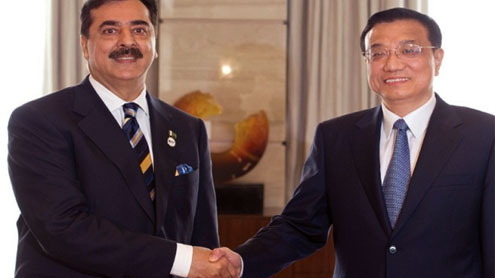
Pakistan and China moved a notch higher than their “time-tested” and “all-weather” friendship status after Pakistan Prime Minister Yousaf Raza Gilani declared that “China’s enemy is our enemy”.

“China’s friend is our friend, and China’s enemy is our enemy. We consider China’s security as our own security,” The Express Tribune quoted Gilani, as saying in a meeting with China’s Executive Vice Premier Li Keqiang at the State Guest House on the sidelines of the Boao Forum for Asia.

Keqiang reciprocated Gilani’s sentiments by saying: “No matter what changes take place at the international level, we will uphold Pakistan’s sovereignty and territorial integrity,” he said. “China supports Pakistan’s role in regional and international affairs.”

China’s reiteration of support for Pakistan’s territorial integrity came after US Congressman Dana Rohrabacher introduced a resolution in the House of Representatives seeking independence for the insurgency-hit Balochistan.

Gilani said Pakistan gives high importance to the security of Chinese citizens on its soil, and added that he was personally monitoring the process to provide them extensive protection.

He added Pakistan realises the importance of maintaining a working engagement with the United States but would not compromise its sovereignty and national dignity.

He was referring to his meeting with the US President Barack Obama in Seoul, where he told him that Pakistan’s Parliament would set the contours of future ties with the US.

Monday, March 19, 2012

Pakistan PM Yousuf Raza Gilani to submit reply to re- open graft cases

Pakistan Prime Minister Yousuf Raza Gilani may submit a detailed reply on today regarding writing to Swiss authorities to re-open graft cases against President Asif Ali Zardari.

As per the Pakistan Supreme Court, Gilani had time till March 20 when it will take a decision on whether or not to go ahead with a case of contempt against him.

On Sunday, Gilani said he was prepared to resign if the issue of approaching Swiss authorities for reopening graft cases against President Asif Ali Zardari was resolved by his departure.

"I will be happy if my quitting the post helps solve this issue," Gilani said while interacting with a group of reporters at his residence in Lahore yesterday.

He referred to a "third option" - resigning from the post of Premier - when asked about the Supreme Court's ultimatum to reopen the cases against Zardari or facing imprisonment for committing contempt of court.

"I am ready for the third option if the matter is resolved. But after my going, a new Prime Minister will have to face the same dilemma," he said.

Over the past few days, Gilani has said he will not write a letter to the Swiss authorities to revive the cases against Zardari as the President enjoys immunity from prosecution under the Constitution.

The Premier has also said he would prefer to be jailed for contempt rather than violate the Constitution by acting on the apex court's orders to reopen the graft cases.

The Supreme Court has set March 21 as the deadline for Gilani to approach the Swiss authorities. The apex court will resume hearing a contempt case against the Premier on the same day.

During an interaction with journalists, Gilani said the issue of the President's immunity should be referred to Parliament just like the issue of the appointment of judges.

"I cannot waive the immunity. Even the President cannot do it. The President has absolute immunity even under international laws," he said.

"The Constitution grants immunity to the office of the President, who is part and parcel of Parliament. Therefore, the supreme legislative body is the best forum to deal with issues related to presidential immunity," he said.

Gilani described as wrong the impression that his Pakistan People's Party was behind the case of the funding of politicians by the Inter-Services Intelligence agency that is being heard by the Supreme Court.

"The judiciary has taken up the matter and will take it to its logical end," he said.

The Pakistan Prime Minister also criticised the government's critics, especially the PML-N, for remaining silent on this issue for 16 years.

"Why did they remain silent for 16 or so years. They could have gone to the court to clear their names," he said.

Monday, February 6, 2012

Prime Minister Yousuf Raza Gilani admits Pak cannot afford war over Kashmir

 Prime Minister Yousuf Raza Gilani on Sunday acknowledged that the Kashmir issue would have to be resolved through dialogue and diplomacy as Pakistan "cannot afford wars" in the 21st century.

Four wars have already been fought on the Kashmir issue and the region still "was a flashpoint", but in the 21st century "we cannot afford wars", Gilani said.

"We want to resolve issues through dialogue, diplomacy, prudent policy and national consensus," he said while addressing a convention at the Prime Minister's Secretariat to mark 'Kashmir Solidarity Day'.

Gilani said the Kashmir issue remained the cornerstone of the country's foreign policy.

"We are committed to continue with the moral, political and diplomatic support to Kashmiris. The whole nation, including all the political parties, is united on the cause of Kashmir," he said.

Since Pakistan is a responsible country and a responsible nuclear power, it has to make responsible policies, Gilani said.

Pakistan's policies should be made through national consensus and by the chosen representatives of the people, and not by individuals, he said.

The Kashmir policy had been the focus of the Pakistan People's Party-led government in line with the vision of the party's founder, Zulfikar Ali Bhutto, he said.

Rallies were held across Pakistan to mark 'Kashmir Solidarity Day', which is a public holiday.

The day has been observed by Pakistan since 1990 to highlight the Kashmir issue. During the rallies, Pakistanis pledged to continue supporting the Kashmiris for what they claimed was their "right to self-determination".

Special prayers were offered at mosques and hundreds of people formed a human chain in Pakistan-occupied Kashmir. Banners calling for Kashmir's freedom were put up along roads in cities and towns across Pakistan.

Citing the policy of Pakistan-China friendship, Gilani told the convention at the PM's Secretariat that the whole country was united on this policy.

As in the case of Pakistan's policy on China, there was no difference of opinion on the Kashmir cause, he claimed. Gilani noted that there were question marks about Pakistan's policy on Afghanistan as it was made by a dictator who wore the four hats of the chairman of the Joint Chiefs of Staff Committee, the Army chief, the president and the chief executive.

Despite his power, the dictator could not sustain pressure after a call from a US under secretary, he said. In contrast, the democratic government closed NATO supply lines, got the US to vacate Shamsi airbase and boycotted the Bonn Conference on Afghanistan after NATO attack on Pakistani border posts in November last year, he said.

President Asif Ali Zardari, in a special message, reiterated Pakistan’s "fullest moral, political and diplomatic support to Kashmiris".

In a separate message, Gilani said "a peaceful settlement of the dispute in accordance with the aspirations of the Kashmiri people is a must to ensure peace and prosperity in the region".

Monday, January 16, 2012

Pakistan crisis: Decisive day for Presiident Zardari, PM Gilani

The political crisis gripping Pakistan could take a decisive turn on Monday when its embattled government appears before the Supreme Court, which is ordering it to reopen a stalled graft probe against the President or face dismissal.

A seven-member bench of the Supreme Court resumed hearing of National Reconciliation Ordinance (NRO) Implementation case today. However, the proceedings were adjourned till 11:30 am.

The crisis comes at a time of continuing strikes by presumed religious extremists who want to install a hard-line Islamist government in the nuclear-armed nation. On Sunday, a bomb blast in eastern Pakistan killed 14 people in a Shi’ite religious procession.

The court hearing represents one front in what amounts to an assault on the government by the powerful military, opposition politicians and the Supreme Court. The showdown has all but paralysed decision making, and threatens fresh turmoil just as the US wants Islamabad's help in negotiating an end to the war with the Taliban in neighbouring Afghanistan.

The fault line is the same one that has plagued Pakistan since its creation in 1947: an Army that can't stomach taking orders from elected politicians, and which has three times seized power in coups. President Asif Ali Zardari's government has given the generals control over foreign and security policy, but the civilian leadership and the top brass have never seen eye-to-eye since Zardari took office in 2008.

Tensions spiked last week over an unsigned memo delivered to Washington last year offering the US a raft of favourable security policies in exchange for its help in thwarting a supposed army coup. Prime Minister Yousuf Raza Gilani criticised the Army for cooperating with a Supreme Court probe into the affair, and has said the standoff is nothing less than a choice between "democracy and dictatorship”.

Gilani's comments followed a warning from the generals — who were infuriated by the memo — of possible "grievous consequences" ahead.

While the Army appears to have little stomach for a coup, government supporters and many independent analysts say the military could be happy to watch the Supreme Court bring down the government for it. The court is a power centre in its own right in Pakistan, and has legitimized past military takeovers.

Gilani insisted on Sunday the government would see out its term in office, scheduled to end in 2013.

"The Parliament was elected for five years and it should complete its term," he told reporters.

Against this backdrop, the Supreme Court has been pressing for investigations into allegations of corruption against Zardari dating back to before his time in office. He and other leading politicians had been protected by a politically inspired amnesty agreed to in 2008 that the court struck down in 2009, leaving him vulnerable.

The government has so far refused to comply, arguing the President has immunity.

Last week, the court threatened to dismiss Zardari and Gilani if they continue to ignore its demands. It ordered government representatives to appear in court on Monday to explain what they planned to do. A senior member of Zardari's Pakistan People’s Party said this week the government would try to get more time from the court, but it's unclear whether the bench is in a patient mood.

Gilani has called for a "show of confidence" vote in Parliament on Monday to support of the government, which could provide a symbolic boost to the embattled Prime Minister.

The court has zeroed in on one corruption investigation taken up by the Swiss government against Zardari that was halted in 2008 when Pakistani prosecutors, acting on the amnesty, told Swiss authorities to drop the case. The court has now ordered the government to contact Swiss authorities to reopen the probe.

Despite the squeeze by the court and the Army, many Pakistani analysts say that early elections may yet take the steam out of the assault. People’s party members privately say such polls are possible, but not until after March, when Senate elections expected to return the party a majority in the upper house are due.

"Once the early polls are announced everything will calm down," said Fakruddin Ebrahim, a former Supreme Court justice and attorney general.

The government is also under fire as a result of the memo sent to Washington.

A separate Supreme Court commission is investigating the note, which some in the media have dubbed "treasonous”. Pakistan's envoy to America, Husain Haqqani, was alleged to have masterminded the memo. He resigned late last year, seeking to limit its fallout. If the commission states Zardari knew about the memo, it could open up another avenue for his foes to challenge his rule.

Meanwhile, the government is hard pressed to stem a wave of violence by the Taliban and other groups which have carried out hundreds of bombings over the last five years that have killed thousands of Pakistani troops and civilians.

There was no claim of responsibility for Sunday's bombing that killed 14 people during a Shi’ite observance in Punjab province in the east.

Hundreds of Pakistani Shi’ites gathered in the town of Khanpur for a traditional procession to mark the end of 40 days of mourning following the anniversary of the death of Imam Hussein, a revered seventh-century figure.

The explosion went off as the mourners left a mosque, said District Police Chief Sohail Chatta. The bomb appeared to have been planted ahead of time in the path of the procession, he said.

The Pakistani Taliban and other Sunni extremist groups have in the past claimed responsibility for the bombings of Shi’ite religious sites and ceremonies. Many Sunni extremists in Pakistan regard Shi’ites as heretics.