Showing posts with label Hillary Clinton. Show all posts

Wednesday, February 29, 2012

US: Having very intense conversations with India, China on Iranian oil

The United States is having "very intense and very blunt" conversations with India, China and Turkey on reducing their dependence on Iranian oil, secretary of state Hillary Clinton has told lawmakers.

Clinton, testifying before a congressional committee on Tuesday, said the US is asking these countries to take specific measures that would reduce their dependence on Iranian oil adding. But, without naming one, she did acknowledge that this would be a bit tough for some countries.

"With respect to China and Turkey and India, we've had very intense and very blunt conversations with each of those countries. I think that there are a number of steps that we are pointing out to them that we believe they can and should make," Clinton said while responding to questions from Senator Robert Menendez.

"In a number of cases, both on their government side and on their business side, they are taking actions that go further and deeper than perhaps their public statements might lead you to believe," Clinton said.

"We are going to continue to keep an absolute foot on the pedal in terms of our accelerated, aggressive outreach to them. And they are looking for ways to make up the lost revenues, the lost crude oil," she said.

Claiming that oil deficit is a difficulty for several other countries, Clinton said US has come up with lots of suggestions that would help these countries in resolving the crisis.

"Our expectation and the direction we are giving to countries is that we do expect to see significant reductions. I am pleased to report, Senator, that we've been aggressively reaching out to and working with countries to assist them in being able to make such significant reductions," Clinton said.

Earlier in the day, testifying before the state, foreign operations and related programs subcommittee of the Senate Appropriations Committee, Clinton told Senators the US is aggressively pursuing sanctions against Iran.

"We are implementing the new Iran sanctions aggressively. The (US) president issued an executive order on February 6th that blocks assets under US jurisdiction of all Iranian banks; also makes it clear that both the departments of treasury and state are expected to enforce the sanctions absolutely," she said.

"We have been travelling the world, high-level teams from treasury, energy and state, to explain what the sanctions are to counterparts around the world. We're very frank in these discussions about the requirements of US law," the US leader said.

Meanwhile, a broad range of countries are making decisions to reduce their dependence on Iranian crude, unwind their dealings with the central bank of Iran, she said.

"We are also pushing very hard to make it clear that we'll help countries that have a significant dependence on Iranian crude to try to find alternatives. It is something that they have to look for. They can't just stop cold turkey and not have anything fuelling their economies," Clinton said.

While referring to the steps being taken by the European Union and Japan, the secretary of state said that some of the major oil producers have set forth their willingness to try to make up the difference.

"We've seen increasing difficulty by Iran in importing and exporting products. They cannot purchase third-party liability coverage for their vessels. So we've stopped them from being insured, which means they can't travel," she said.

Clinton added that the Japan, which lost much of their electricity production because of the earthquake and the Fukushima nuclear power plant meltdown, had reduced their imports from Iran in the range of 15 to 20 per cent since last year and is looking for new suppliers.

Friday, December 9, 2011

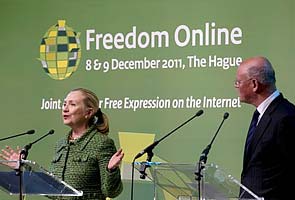
Hillary Clinton warns Internet firms against autocratic governments

US Secretary of State Hillary Clinton on Thursday warned Internet firms to avoid offering the "tools of oppression" to authoritarian Middle East regimes trying to crush democracy protests.

Clinton urged private companies to "embrace their role in protecting Internet freedom" and ensure protection of ordinary people as well as political activists.

Speaking at an Internet conference in The Hague, the chief US diplomat cited cases where "companies' products and services were used as tools of oppression," without naming the companies.

Companies have reportedly turned over sensitive information to governments about dissidents or shut down social networking accounts of activists involved in a political debate, she said.

"Today's news stories are about companies selling the hardware and software of repression to authoritarian governments," she told the Google-sponsored gathering.

"When companies sell surveillance equipment to the security agency of a Syria, or Iran, or in past times Gaddafi, there can be no doubt that it will be used to violate rights," she said.

Activists have used Facebook, Twitter and other Internet technology to organize protests against the rule of Syrian President Bashar al-Assad, Iranian President Mahmud Ahmadinejad, and Libyan leader Moamer Gaddafi.

Assad has used deadly violence against protests since March, Ahmadinejad staged a lethal crackdown on protests following disputed elections two years ago, and Gaddafi was overthrown in August and eventually killed in October.

She said "smart companies" decide before being asked by their governments to avoid dealing with countries that use repression.

Clinton also warned against bids by repressive governments to use international fora to impose national barriers on the Internet by upending the public-private partnership now governing it.

"This approach would be disastrous for Internet freedom. More government control will further constrict what people in repressive environments can do online," Clinton said.

"It would also be disastrous for the Internet as a whole, because it would reduce the dynamism of the Internet for everyone," she said.

Clinton aides said the comments referred to a Code of Conduct for Information Security that was introduced by Russia, China, Tajikistan and Uzbekistan at the UN General Assembly in September.

China's Internet controls have already become a key irritant in relations with the United States, especially after a dispute over Chinese censorship led US search engine giant Google to cut back in China.

She said Washington supports the existing "public-private collaboration" that runs the Internet as it evolves in real-time, as well as the principles of multi-stakeholder Internet governance developed by the OECD this year.

"A multi-stakeholder system brings together the best of governments, the private sector, and civil society. And it works," she said.

Friday, December 2, 2011

Pro-democracy leader Suu Kyi welcomed US engagement

Pro-democracy leader Aung San Suu Kyi welcomed on today US engagement with Myanmar saying she hoped it would set her long-isolated country on the road to democracy.

US Secretary of State Hillary Clinton held a final meeting with Suu Kyi as she wrapped up a landmark visit to Myanmar which saw the new civilian government pledge to forge ahead with political reforms and re-engage with the world community.

Hillary and Suu Kyi - the Nobel laureate who has come to symbolize the pro-democracy aspirations of Myanmar's people - held a private dinner on Thursday and met again on Friday at Suu Kyi's lakeside home, effectively her prison until she was released last November after years in detention.

"We are happy with the way in which the United States is engaging with us and it is through engagement that we hope to promote a process of democratization," said Suu Kyi, adding that Hillary’s visit was a "historical moment" for both countries.

The two women spoke together for about an hour and a half. They later stood on a verandah, holding hands as they spoke to reporters.

Hillary’s trip follows a decision by US President Barack Obama last month to open the door to expanded ties, saying he saw "flickers of progress" in a country until recently seen as a reclusive military dictatorship firmly aligned with China.

Suu Kyi said she welcomed more support for Myanmar including World Bank and International Monetary Fund assessment missions which she said would help the country figure out how to get its economy on track.

She also called on the military-backed government to do more to ensure the rule of law, which she said would prevent the arrest of more political prisoners.

She said she would work with the new government, the opposition and friendly countries including the United States and China for a better future for her country.

Hillary’s trip - the first by a senior US official in more than 50 years - represents an opportunity for both Myanmar and the United States, and both appear eager to press ahead with rapprochement.

Myanmar's new leadership hopes the United States will eventually see its way clear to ease or remove sanctions, a step which could open the resource-rich but desperately poor country to more foreign trade and investment and help it catch up to booming neighbors such as Thailand and India.

Myanmar`s Suu Kyi praises US engagement For Washington, improved ties with Myanmar could underscore Obama's determination to up US engagement in Asia and balance China's fast-growing economic, military and political influence.

Wednesday, November 30, 2011

US asks Pakistan to reconsider Afghan talks boycott

The US has asked Pakistan to reconsider its decision to boycott an international conference on Afghanistan in Bonn next week, saying it is in Islamabad's interest and that its participation was "very important" for the future of the war-torn country.

US Secretary of State Hillary Clinton while voicing regret at Pakistan's decision hoped it would reconsider and find a "follow-up way" to take part in the talks in Germany.

85 nations and 15 international organisations are due to attend the crucial international meet starting on December 5.

Addressing an aid conference in South Korea, Ms Clinton reiterated the US position that the border killing of Pakistani soldiers was a "tragic incident" and pledged an investigation "as swiftly and thoroughly as possible."

"Frankly this is regrettable that Pakistan has decided not to attend the conference in Bonn because this conference has been long in the planning," Ms Clinton later told reporters.

"Pakistan like the United States has a profound interest in a secure, stable and increasingly democratic Afghanistan," she said.

Yesterday, Pakistan announced its decision to boycott the Bonn talks in protest against the killing of 24 of its soldiers by NATO forces in a cross-border fire on the Af-Pak border over the weekend. The incident was described by the Pakistani Army as a "deliberate act of aggression".

"We certainly urge Pakistan to participate in this conference. It's very important for the future of Afghanistan," White House Press Secretary Jay Carney told reporters here.

"Pakistan obviously will play an important role in the future of Afghanistan, and we urge them to participate in the conference," Mr Carney said in response to a question.

The US State Department also echoed White House's sentiments.

"It is important to note that this conference is about Afghanistan, about its future, about building a safer, more prosperous Afghanistan within the region. So it's very much in Pakistan's interest to attend this conference," State Department spokesman Mark Toner told reporters.