Showing posts with label FDI in retail. Show all posts

Wednesday, December 7, 2011

To run Parliament, Govt puts brake on retail FDI

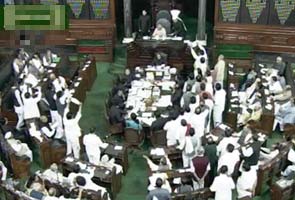
Amidst the continuing row over allowing FDI in retail, the government on Wednesday succeeded in convincing the Opposition to let Parliament function.

The government and the opposition agreed at an all-party meeting held this morning that Parliament should not be held hostage to continuing logjam over the retail FDI issue.

At the meeting chaired by Finance Minister Pranab Mukherjee, the government told the opposition parties that it was suspending the Cabinet decision on allowing 51 per cent FDI in multi-brand retail and 100 per cent FDI in single brand retail.

Further, Mukherjee will today make a one-line statement in Parliament, announcing the decision to hold back implementation of Cabinet’s retail FDI decision. Both Houses would then adopt a government resolution suspending 51 per cent FDI in retail "till a consensus is developed through consultations with various stakeholders".

Commenting on the agreement, the CPI said this is a "virtual rollback" of the FDI decision.

Opposition parties had earlier been pressing the government on a complete rollback of the decision.

The government had over the last few days reached out to its key ally Trinamool Congress and the opposition to signal its willingness to "pause" the FDI decision.

Finance Minister Pranab Mukherjee Monday spoke to BJP leaders LK Advani and Sushma Swaraj and CPI(M) leader Sitaram Yechury to convey the government's decision to put the FDI decision in abeyance.

The BJP had on Tuesday sharpened its attack on the government with its leader Arun Jaitley questioning "silence" of Congress president Sonia Gandhi and party general secretary Rahul Gandhi on the FDI issue.

"The government decided to allow FDI in retail November 25. Till now, I did not get the opportunity to know the views of the party president (Sonia Gandhi), or general secretary (Rahul Gandhi), whom they consider leader of future," Jaitley said at a rally here.

Nearly half of the Winter Session has been lost due to protests and slogan-shouting by opposition members over various issues, mainly FDI in retail.

Tuesday, December 6, 2011

Debate rages in India over allowing FDI

For multinational merchants like Wal-Mart, it seemed to be the long-awaited opportunity to jump into India with both feet. But on Monday that moment appeared to be delayed once again.

Late last month, as part of a push to modernize his nation's notoriously inefficient retail economy, Prime Minister Manmohan Singh announced that for the first time big foreign companies like Wal-Mart and the British company Tesco could open retail stores in India.

Until now, foreign companies have been restricted to serving only as wholesalers in India. That has already helped create more modern distribution networks, often while generating better prices for farmers and other producers, and giving customers better deals, too.

But expanding the foreign presence to retailing has been seen as the necessary next step for modernists like Singh, who has been urging the move for years. Praise for his announcement came from India's corporations and some of its 175 million farmers, who see the move as part of a wave of changes that might help jolt a slowing economy.

And opponents - representing the 34 million people who work in retail and wholesale businesses, as well as left-leaning politicians - were just as loud.

On Monday, leaders of two opposition parties said finance minister, Pranab Mukherjee, had agreed to a delay. Mukherjee is expected to make a statement in Parliament on Wednesday.

All of this places Wal-Mart in a position hardly new to the company: at the center of a raging debate that pits the multinational giant from Bentonville, Ark., against local mom-and-pop businesses.

For more than a year, Wal-Mart has been operating a wholesale outlet in this northern city known for its fertile farms and hearty food. Local businessmen like Ravi Mahajan, whose family has had a wholesale general store in the narrow alleys of the Imam Nasir market for 40 years, say their sales have been cut in half as their customers - retail shopkeepers - stock up at Wal-Mart.

If the government eventually lets foreign firms expand beyond wholesaling to open retail stores, Mahajan said, many of his retail customers would be forced out of business, while squeezing out traders like himself who have long served as the crucial middleman in Indian commerce.

"We'll be destroyed," Mahajan said last week, minutes after he and dozens of other traders burned an effigy with a bloated belly and a crudely drawn face, meant to represent multinational marauders.

But Indian business is far from united in opposing foreign retailers.

Farmers like Avtar Singh Sidhu, who sells potatoes to PepsiCo for its Lays chips and has sold baby corn and other vegetables to Wal-Mart's local partner, the Indian conglomerate Bharti, argues that foreign retailers will be a boon to India's struggling agricultural sector. The multinationals, he said, will buy directly from farmers and pay better prices than local wholesalers.

Already, he said, PepsiCo is offering 6 rupees per kilo (or 11 cents) for his potatoes, while local traders offer only 3 rupees (6 cents). "We need more competition," Sidhu said.

Policymakers are looking for ways to stimulate economic growth, which fell to an annual pace of 6.9 percent in the three months that ended in September. It was the first time India's growth rate had fallen below 7 percent in two years.

The announcement by Singh's administration on Nov. 24 called for allowing foreign companies like Wal-Mart to team up with Indian partners to open retail stores in metropolitan areas with more than 1 million people. Jalandhar has 2.1 million people.

Monday, December 5, 2011

'Govt puts retail FDI on hold, to rework policy'

Amid growing opposition to its decision of allowing foreign direct investment (FDI) in retail sector, the UPA government on Monday decided to put the issue on the back burner.

Highly-placed sources told  that the government has decided to halt the implementation of the decision to allow 51% FDI in multi-brand retail and 100% FDI in single-brand retail for now.

An official announcement to this affect will be made in Parliament by Finance Minister Pranab Mukherjee when it meets next on Wednesday, reports said.

Moreover, sources said the government is mulling reworking its policy on allowing FDI in retail, amid opposition from not just the opposition parties but also from its allies - the DMK and the Trinamool Congress.

The development came after Pranab Mukherjee spoke to Leader of Opposition in Lok Sabha, Sushma Swaraj of BJP and CPI(M)’s Sitaram Yechury today.

Mukherjee is reported to have discussed with the two leaders the continuing logjam in Parliament, stressing it was sending a wrong signal to the nation. He is believed to have apprised the two leaders about the government’s decision of putting FDI in retail on hold.

Sources said Yechury told Mukherjee that the Left would not bring a no-confidence motion against the government now.

The decision to allow FDI in retail was taken by the Union Cabinet on November 24. And since the next day the Opposition has not allowed Parliament to function demanding a discussion on the issue under a rule that entails voting.

Following resistance from the opposition as well as its allies, the government had on November 30 delayed issuing notification regarding its decision on allowing FDI in retail.

The government had so far maintained that it was ready for a discussion on the issue in Parliament but not under adjournment motion that entails voting. The UPA had maintained that the decision was an executive one for which the government was not bound to seek approval from Parliament.

Meanwhile, the Congress has issued a whip directing all its MPs to be present in Parliament on Wednesday.

Also on Wednesday, the Congress has called a meeting of its parliamentary board at 9.30 am. That meet will be chaired by Pranab Mukherjee.

Friday, December 2, 2011

Pranab: Economic growth will moderate to about 7.5 percent

Confirming a slowdown, Finance Minister Pranab Mukherjee on Friday said economic growth will moderate to about 7.5 percent in the current fiscal, lower than the earlier projection of 9 percent.

"I am confident that we will be covering some of the losses in our growth momentum and may end the year with over 7.5 percent," he said while addressing the Hindustan Times Leadership Summit here.

GDP growth in 2010-11 stood at 8.5 percent.

The economy expanded at the slowest pace in two years at 6.9 percent in the July-September quarter of the current fiscal. For the first half (April-September) of the fiscal, the average growth rate stood at 7.3 percent.

GDP growth in the second quarter of the fiscal slowed to 6.9 percent from 8.4 percent in the corresponding period last year, mainly on account of rising interest rates and the uncertain global scenario.

The tight monetary policy employed by the RBI to tame inflation affected the performance of manufacturing and other infrastructure sectors, with the eight core industries recording only 0.1 percent growth in October, the lowest in the last five years.

In the Budget for 2011-12 fiscal, Mukherjee had projected a GDP growth rate of 9 percent plus/minus 0.25 percent.

"My growth projection was on the basis of achievements which we have immediately after the international financial crisis of 2008," he said, adding, "I am modest. I have not said that I will be reaching the figure I projected in the Budget."

"We can not expect we can reach a high growth rate of 9 percent overnight. We will have to live with relatively moderate growth this year. Next year, we will try to improve the growth rate higher. This year, growth could be 1 percent down. We should focus on the strategy of domestic demand-driven growth," he said.

Mukherjee said considering the current global context and slowdown in the domestic industrial sector, "The growth performance is not at all disappointing."

Earlier this week, Mukherjee had said the Indian economy is battling both global and national problems and this is getting reflected in the growth numbers.

"We have been confronting the challenge posed by inflation in the past two years. Sustained high economic growth has led to improvements in purchasing power in both rural and urban areas," Mukherjee said.

Overall inflation has been above the 9 percent-mark since December, 2010. It stood at 9.73 percent in October.

Food inflation, which accounts for 15 percent of overall inflation, fell to 8 percent for the week ending November 19 after remaining elevated for four months.

He said the rise in purchasing power has accentuated demand-supply imbalances in some specific commodities, like vegetables, fruits and protein-rich items.

"In addressing this issue, we have taken both short-term fiscal and administrative measures and also medium-term steps to improve supply response," Mukherjee said.

He said in the short and medium-term, the country should emphasise on domestic demand-driven growth to ward off the adverse impact of the global crisis and improved productivity in agriculture is necessary to meet the objective of inclusive growth.

"We have already began the process of fiscal consolidation. Though it may appears extremely difficult, I am hopeful of fiscal balance targeted for the current financial year. The state governments also need to work toward fiscal sustainability," Mukherjee said.

Let politics not block valuable foreign equity retail: Pranab

Farmers and consumers will be the casualties if foreign equity in retail trade is blocked due to narrow political gains, Finance Minister Pranab Mukherjee said Friday, calling for a debate at the right forum rather than confrontation.

Speaking at the Hindustan Times Leadership Summit here, the finance minister said global experience showed how organised retail, with integrated supply chains, cuts post-harvest wastage and gets remunerative returns to farmers and competitive prices to the consumer.

"But that needs appropriate technology and investment in a large scale," he said.

"Yet, despite this recognition, often narrow political gains take precedence over early implementation of a policy framework, even when it is being done in a calibrated and sensitive manner," Mukherjee said, referring to opposition over foreign retailers.

According to him, such policies were needed for an emerging economy like India to ensure improvement in efficiencies to vigorously pursue and sustain high growth that can also be equitable across states and between urban and rural areas.

"But in the absence of timely action or no action at all, it is the farmer and consumer who will suffer, as the nation would miss out on an opportunity."

Opposition parties have stalled functioning of parliament ever since the federal cabinet, in a meeting presided over by Prime Minister Manmohan Singh, approved up to 51 percent foreign equity in multi-brand retail and 100 percent in single brand format.

Even some allies of the United Progressive Alliance (UPA) such as West Bengal Chif Minister Mamata Banerjee-led Trinamool Congress and former Tamil Nadu chief minister's M Karunanidhi's DMK have opposed the move.

Thursday, December 1, 2011

Protest against Centre’s decision to allow FDI

The nationwide shutdown (Bharat Bandh) called by millions of traders to protest against Centre’s decision to allow foreign direct equity into the retail market has hit normal life with major shops remaining closed and business activities put to halt.

Reports, Thursday, claimed that nearly five crore traders have taken the fight against government’s retail FDI move to streets.

According to reports, all major trade unions across the country are supporting today’s bandh forcing all medium-small commercial complexes and retail stores to keep their shutter down.

Traders in several states including West Bengal, Uttar Pradesh, Delhi, Gujarat, Orissa, Madhya Pradesh, Chhatisgarh, Uttarakhand and others are holding protests in their local markets. They are also demonstrations in front of foreign stores.

Big markets like Karol Bagh, Sadar Bazar, Kamla Nagar, Chawri Bazar, Kashmere Gate, Tilak Nagar, Rohini, Krishna Nagar and Greater Kailash M Block remained closed while Sarojini Nagar and INA markets functioned as usual.

Neighbourhood shops were also open even as the one-day protest received support from political parties like BJP and Left parties.

BJP joined the traders' protest by organising marches and burnt the effigies of Prime Minister Manmohan Singh and Delhi Chief Minister Sheila Dikshit in at least 20 locations of the city.

Confederation of All India Traders' (CAIT) Delhi unit president Narender Madan said a large number of traders have kept their shops shut to participate in the all-India bandh.

In view of today’s shutdown, several foreign retail giants such as Bharti-Walmart, Tesco and Carrefour have decided to either keep their stores closed or beefed up the security of their stores.

A large number of private security guards have been deployed to vigorously check customers and vehicles entering their premises.

The government has recently triggered a political storm by allowing its decision to allow 51% foreign investment in the multi-brand retail sector, but has since faced stringent criticism as protests have swelled from opposition parties and some of its own allies.

It has prompted anti-Congress forces to join hands to train their guns, against the Congress and especially against AICC general secretary Rahul Gandhi, ahead of the crucial Uttar Pradesh Assembly elections.

The main opposition party BJP and the Left have declared their full-hearted support to the call for today’s Bharat Bandh announced by various traders’ organisations.

BJP-ruled State Chief Ministers have announced that they will not follow the Centre in allowing the FDI into the multi-brand sector. Madhya Pradesh Chief Minister Shivraj Singh Chauhan was the first to declare that he would ensure that the retailers and farmers do not suffer due to the FDI policy of the Centre and therefore would not allow the FDI entry in the retail sector in his state.

UP Chief Minister Mayawati has alleged that FDI decision was taken to help Rahul’s friends. “Rahul Gandhi has always stayed abroad and earlier he used to get his foreign friends to stay in the houses of poor people in Uttar Pradesh, make fun of poverty and now they are getting foreign companies into India,” Mayawati stated.

The war over allowing FDI in multi-brand retail escalated with the opposition BJP squarely rejecting the government's plea for toning down its adjournment motion.

The issue also led to the adjournment of both Houses of Parliament for the seventh straight day, without transacting any business. The entire opposition has demanded rollback of the controversial decision.

The government is trying to mollify its allies and bring them onboard as far as the decision on FDI is concerned, before it makes any concessions to the Opposition which has stalled Parliament on the issue.

Meanwhile, Union Commerce Minister Anand Sharma is set to brief Congress MPs on the issue today.

Monday, November 28, 2011

War over FDI in retail in Parliament

For Parliament, its day at work ended by noon. Both houses were adjourned till tomorrow - a consequence of the stand-off between the opposition and the government over the latter's decision to increase Foreign Direct Investment or FDI in the retail sector.

The opposition wants to discuss the government's decision under an adjournment motion - which would end with a vote. The government has rejected this - it wants a debate, but no vote.

Sharad Yadav of the Janata Dal says he will ensure Parliament does not function till the government withdraws its decision to allow 51% FDI in the multi-brand retail sector, a move that would allow giants like Walmart and Tesco to set up shop in India.

The list of parties and states attacking the move to increase FDI in retail is embarrassing for the government - some of its most important allies like Mamata Banerjee have expressed their dissent; so has the Congress party's branch in Kerala. And today, DMK chief M Karunanidhi, also a senior member of the UPA with 16 Lok Sabha MPs, asked the government to reverse its decision.

An adjournment motion allows a member of the House to ask that regular business be suspended to discuss an urgent matter of public interest.  It includes a debate and ends with a vote that tests the government's strength. The opposition's insistence on a vote is seen as a pressure tactic - what it really wants is for the government to put its decisions on retail on hold till the matter is extensively debated in Parliament. 

In the Rajya Sabha, Jayalalithaa's party, the AIADMK, moved a notice for an adjournment motion. Senior BJP leader Murli Manohar Joshi had planned a similar course of action for the Lok Sabha. The BJP's Arun Jaitley told an hour before Parliament opened that, "FDI will hurt Indian economy...The sense in the country is against FDI...Government's decision on FDI will have a political fallout."

And Gujarat Chief Minister Narendra Modi confirmed his presence on a long list of chief ministers who are fighting the government over FDI in the multi-brand sector on the grounds that it will wipe out lakhs of small mom-and-pop stores. "My stand is the same as that of my party BJP & which is in the interest of the nation," Mr Modi tweeted this morning.

Yesterday, Leader of Opposition in the Lok Sabha, Sushma Swaraj had tweeted, "Parliament is in session and Government announced a decision of such far reaching consequences outside Parliament. It is a contempt of the House."

Unlike last week, when the UPA government managed to avoid an adjournment motion over the issue of black money as demanded by the BJP, this time it wouldn't be smooth sailing. Sources in the BJP have told that since the government did not admit the adjournment motion on black money on technical grounds, there is no reason why they can't bring one on FDI. Sources also say that if the government rejects the current motion arguing that the one on black money had already been proposed, the BJP is also considering a no-confidence motion.

The government has real cause for concern given the fact that the BJP has found backers over the FDI issue in AIADMK chief J Jayalalithaa, Trinamool Congress chief Mamata Banerjee and BSP chief Mayawati - the three women chief ministers of Tamil Nadu, West Bengal and Uttar Pradesh.

Mamata Banerjee is a UPA ally and has partymen as important ministers at the Centre. But she does not support FDI in the retail sector. "Some people can support 51 per cent FDI in retail but I do not support it. You see, America is America, Bangladesh is Bangladesh, Pakistan is Pakistan and India is India. I have to take into account how much capacity I have, how much is my ability. There are so many shops here. If these shops close what would the shop owners eat?" the Trinamool Congress chief said.

Nearer home in poll-bound Uttar Pradesh, Mayawati, at a Dalit rally on Sunday, used the FDI issue to target Congress General Secretary Rahul Gandhi. "To please the yuvraj, the FDI in retail has been allowed to benefit his foreign friends," she had said.

The war cry from the three women Chief Ministers indicates that the implementation of FDI in states will be difficult. Even in Congress-ruled Kerala, the state party chief Ramesh Chennithala has written to the PM opposing the move.

Opposition, allies, reluctance even at home. But the UPA government is not blinking. It shrugs off the Opposition's charge that it was not consulted.

"Privately, many members of different political parties including the BJP have been talking to us. And they have all been saying privately please do it. Why are you waiting? It doesn't require Parliament sanction. Why don't you do it? And now they stand up and do this," Law minister Salman Khursheed said.