Showing posts with label Bhagavad Gita. Show all posts

Thursday, December 29, 2011

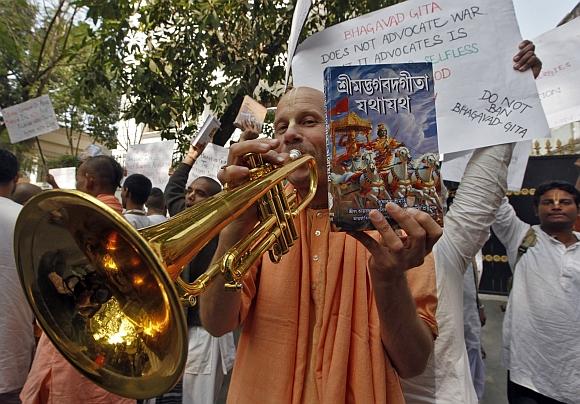
Russian court rejected ban on Bhagwat Gita

A Russian court on Wednesday rejected a petition seeking a ban on translation of Bhagavad Gita, bringing cheers to crores of Hindus across the world.

The petition in the Siberian city of Tomsk called Bhagvad Gita, one of Hinduism's holiest scriptures as "extremist literature" and said it promotes "social discord" and “hatred towards non-believers”.

Russian lawyers Mikahil Fralov and Alexander Sakhav argued vociferously against the petition.

The case filed by state prosecutors in Tomsk claimed that the renowned translation of the text, titled "Bhagavad Gita As It Is" is "extremist literature" and should join Adolf Hitler's Mein Kampf in the list of banned books.

"Bhagavad Gita As It Is" -- first published in 1968 -- is a translation of and commentary on the original text by Swami Prabhupada, the founder of the international Hare Krishna movement, ISKCON.

The judge, after reviewing the petition from the state prosecutors and the responses against it, dismissed the plea.

"We have won the case. The judge has rejected the petition," Sadhu Priya Das of ISKCON, who is also the Chairman of newly formed Hindu Council of Russia said.

Reacting to the judgement, ISKCON spokesman Brajendra Nandan Das said in New Delhi that, "We are very happy".

Meanwhile, External Affairs Minister SM Krishna welcomed the judgement and thanked the Russian government for its support.

ISKCON members have linked the court case to the Russian Orthodox church, which they claim wants to limit their activities in Russia.

The case had created a storm back in India. Speaking in Parliament, Krishna called the lawsuit "patently absurd". He had summoned the Russian Ambassador in New Delhi, Alexander Kadakin, on the eve of the court hearing and told him that Moscow should provide all possible help to resolve the issue.

He also conveyed to the Russian diplomat the sensitivities involved with the issue. Kadakin had assured Krishna that the Russian Government will do all it can within its power.

The trial began in June and was scheduled to conclude on December 19, just after Indian Prime Minister Manmohan Singh's two-day visit to Russia.

However, officials in Tomsk agreed to hear further testimony from experts and the Russian ombudsman for human rights and postponed the court decision till today.

Wednesday, December 28, 2011

Russian court to decide on Hindu scripture Gita ban today

A Siberian court will on Wednesday pronounce its verdict in response to a petition moved by a group connected to the Christian Orthodox Church seeking a ban on sacred Hindu scripture Bhagavad Gita.

The group wants the court to declare Bhagvad Gita an "extremist text".

New Delhi has already expressed its serious objections to the Christian Orthodox Church’s move to get Bhagvad Gita banned in Russia.

Ahead of the court hearing in Tomsk city, External Affairs Minister S M Krishna yesterday conveyed to Russian Ambassador Alexander Kadakin the country's concern over the "sensitive" issue, which has created an uproar in India.

Krishna told the Russian Ambassador that Moscow should provide all possible help to resolve the issue.

During the meeting, Kadakin assured Krishna that the Russian Government will do all it can within its powers.

"The External Affairs Minister conveyed the concerns of the Parliament of India and the people of India on the issue. The Russian side has been saying that it is a judicial process and that it will take all steps it can within its power (to resolve the issue)," the reports said.

Earlier, Russian Ombudsman Vladimir Lukin in his statement had declared that "Bhagavad Gita As It Is" written by A C Bhaktivedanta Swami Prabhupada, the founder of the International Society for Krishna Consciousness (ISKCON), is a globally respected book.

He also stated that it was unacceptable to seek a ban on it in Russia.

Separately, at an emergency meeting Hindus from India, Bangladesh, Mauritius, Nepal and other countries residing in Russia have also set up the Hindu Council of Russia to defend their interests.

Tuesday, December 20, 2011

India takes Gita issue with Russia authorities

India has strongly taken up the demand for banning Hindu scripture Bhagavad Gita, which a group linked to the Christian Orthodox Church has described as 'extremist', with the Russian authorities, Indian Ambassador to Russia Ajai Malhotra said.

"The matter has been taken up by the Indian Embassy in Moscow with the Russian Government at senior official level, seeking its favourable and positive intervention in the matter," Ambassador Malhotra said, as the court in Tomsk postponed its ruling on the petition banning Bhagwad Gita as 'extremist' and allegedly 'sowing' social-discord in Russia.

Describing Bhagwat Gita as extremist, a group linked to the Christian Orthodox Church has demanded ban due to conflict of interests between the Russian followers of Lord Krishna and the local authorities in the Siberian region of Tomsk.

Malhotra personally and his mission here have been publicly expressed their support to the local chapter of International Society of Krishna Consciousness (ISKCON).

The final hearing in the Tomsk District Court is scheduled for December 28, as the Court agreed to seek the opinion of the Russian Ombudsman on Human Rights in Tomsk Region and of Indologists from Moscow and St Petersburg (all of whom favour dismissal of the case).

The case pertains to the legal relationship between a Russian registered socio-cultural organization and the local authorities. Nevertheless, the Embassy in Moscow has been publicly supportive and sympathetic in the matter.

"We believe that there are new operational concepts that link the Indian Ocean with the Pacific Ocean, we want to talk about the manifestations of that, both in terms of maritime security and other aspects of commerce and security interactions and we would talk about developments among all the key countries in the Asia Pacific region," Campbell said.

"But our talks wouldn't end there. There would also be talks on global issues. I am very excited about these developments and I think they have the potential to advance trust and understanding among all three Capitals," he said.

Campbell said the future prospects of India-US-Japan dialogue depends on progress of the today's meeting. "Well, it has taken us some time to set up this meeting.

I think, we all will see how this one goes. I think, we will make our assessment after that. We certainly would be open to more frequent discussions, but all parties would have to be comfortable with that. And I think, what we are trying to do is to take step at a time and just see how this first set of interactions goes," he said.